It is important to acknowledge that I am non-Indigenous but I am an ally. I have immersed myself in Indigenous Education so that way when I become a teacher, I can authentically and professionally, incorporate Indigenous ways of knowing and being and the First Peoples Principles of Learning in my practice.
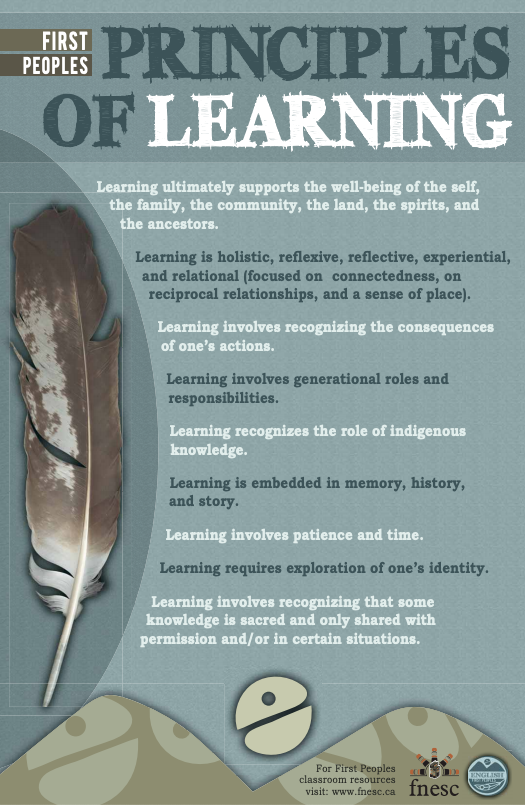
What are the First Peoples Principles of Learning?
The FPPL are not lessons and are not a unit plan. They are standards that help educators plan and teach with more intent and support the success of our Indigenous learners and all learners. By authentically embedding the FPPL in our daily practice, we, as educators, play a key role in Reconciliation.
“However, the principles that govern traditional First Peoples’ Perspectives of teaching and learning have gained a more prominent place in the BC education system as educators are recognizing that they promote educational practices that are also powerfully effective for non-indigenous learners, and are paralleled by some other non-indigenous education theory, that is replacing the post-industrial model of education that has been entrenched in Canada’s education systems.”
Jo Chrona
When looking at the First Peoples Principles of Learning (listed below), a common theme would be “Education is a complex process that is personal, holistic; embedded in relationship to each other, self, and to the land; and is most effective when it is authentic and relevant.” (J. Chrona).
- Learning ultimately supports the well-being of the self, the family, the community, the land, the spirits, and the ancestors.
- Learning is holistic, reflexive, reflective, experiential and relational (focused on connectedness, on reciprocal relationships and a sense of place).
- Learning involves recognizing the consequences of one’s actions.
- Learning involves generational roles and responsibilities.
- Learning recognizes the role of Indigenous knowledge.
- Learning involves patience and time.
- Learning is embedded in memory, history, and story.
- Learning requires the exploration of one’s identity.
- Learning involves recognizing that some knowledge is sacred and only shared with permission and/or in certain situations.
What can we do as educators?
I believe that educating ourselves in Indigenous ways of Knowing and being will allow us to authentically embed the FPPL into our lessons and daily routine. We need to further educate ourselves on appropriation, what that is and what it means. Appropriation is when a Non-Indigenous person claims elements of Indigenous knowledge as their own (J. Chrona). Furthermore, it is important to teach our students how easy it is to take Indigenous knowledge which is often context-specific and misinterpret, misrepresent, or misuse it. Ultimately teaching them how to not culturally exploit our local First Nations and any First Peoples. Lastly, as educators, we can utilize any and all resources available to us.
Some Resources:
- IEW (Indigenous Education Workers)
- Dakelh Holistic Lifelong Learning Model
- https://curriculum.gov.bc.ca/curriculum/indigenous-education-resources/indigenous-knowledge-and-perspectives-k-12-curriculum
- https://www2.gov.bc.ca/gov/content/education-training/k-12/administration/program-management/indigenous-education
- https://www2.gov.bc.ca/gov/content/education-training/k-12/support/indigenous-focused-graduation-requirements
- http://www.billposer.org/LheidliCarrierDictionary/
- https://www.lheidli.ca/about/our-language/
- https://www.firstvoices.com
- Indigenous Education Unit Plan (Link available on the back of The Dakelh Learning Model)
- Indigenous Education Lesson Plan (Link available on the back of the Dakelh Learning Model)
- http://www.pgdta.ca/uploads/2/4/1/7/24178565/lheidli_tenneh_natural_calendar_framework__2020-2021_.pdf
- https://curriculum.gov.bc.ca/competencies
- https://www.fnesc.ca/learningfirstpeoples/
- http://media3.sd57.bc.ca/SD57
It is no secret that schools were once used as a punishment to Indigenous peoples and as a result of that we have many children coming into our schools with intergenerational trauma. More than half our students childhood and educational career is spent in the classroom and at school. It is our job to build relationships, be understanding, be kind, be willing to try, and be a life long learner to benefit our students. One of my major takeaways from Indigenous ways of knowing and being is that learning can happen anywhere, it does not need to be within the classroom.
As an teacher, I will always strive to:
- Continue my education to benefit my students & community, self, and the land.
- Foster an inclusive, holistic, engaging and safe classroom environment.
- Enrich my connection and my student’s connect to others, culture, place, and land.
- Always look through a trauma-informed lens.
- Utilize the outdoor classroom.
- Provide my students with many opportunities to discover one’s self. Embrace their strengths and weaknesses and make sure they feel valued and heard.
- Authentically include Indigenous ways of knowing and being to further embedded the FPPL in my teaching practice.
*NOTE* The resources above are what I used to write this page – specifically Jo Chronas Blog.